

Yuichi Yokoyama grew up in Miyazaki, Japan, and studied oil painting at Musashino Art University before turning to manga around 2000. He chose to use sequential images of manga because, as he puts it, it lets him “draw time.” His approach — often called “neo-manga” — strips away conventional storytelling and emotion in favor of pure motion, rhythm, and transformation. His books have been published internationally, and his work is held by institutions including the National Museum of Modern Art, Tokyo and Mori Art Museum.
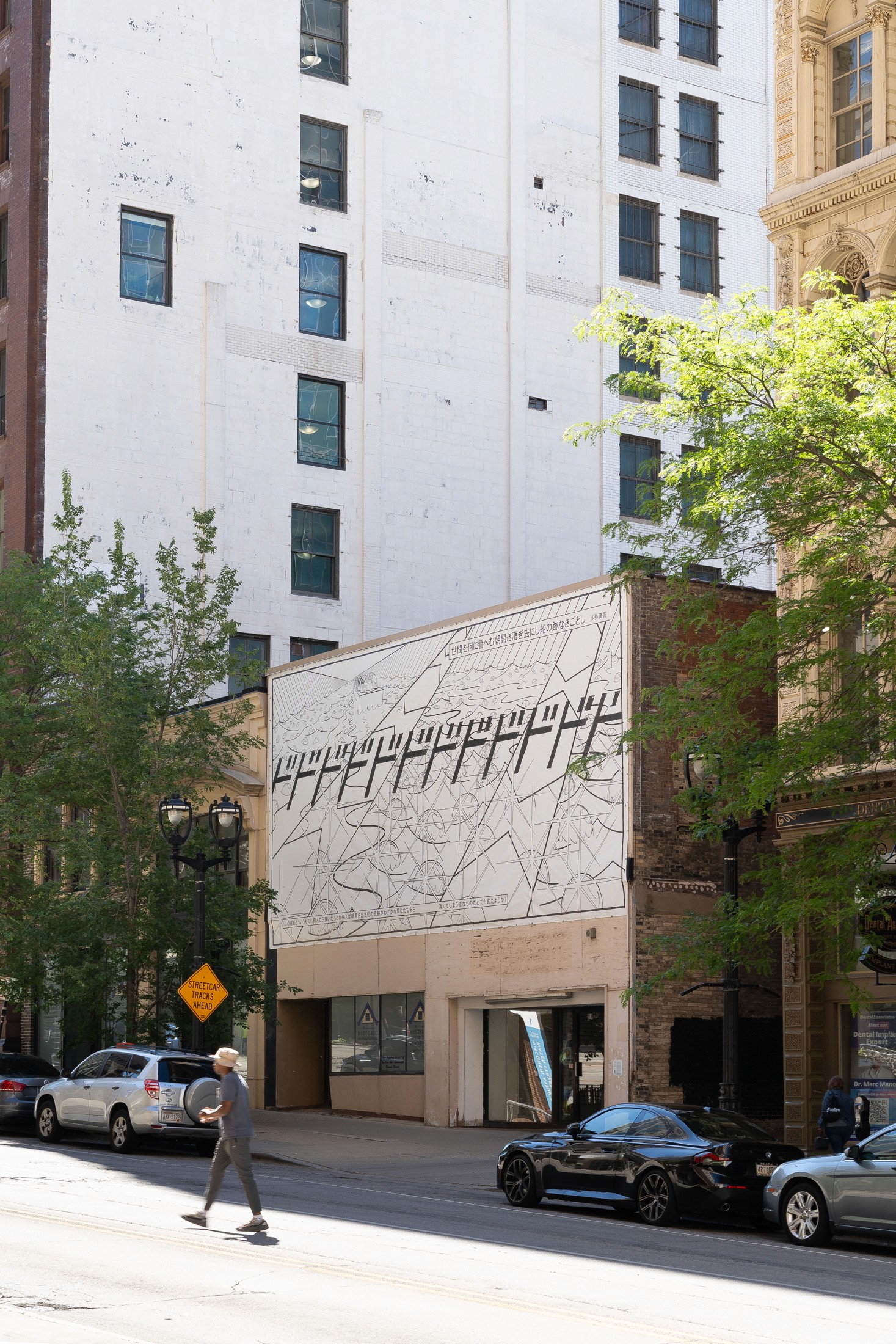
This large-scale billboard is his first public installation in the United States. It comes from Neo Manyo (PIE International, 2023), a book in which 22 manga stories reimagine classical Japanese waka poetry through Yokoyama’s visual imagination — drawing from sources including the 8th-century anthology Man’yōshū, one of Japan’s oldest surviving poetry collections. The scene shown here depicts a ship moving through churning water. The bold lettering across the center — ドドド (dododo) — is onomatopoeia for the roar of waves, a sound made visible. The poem accompanying this scene was written by the Buddhist monk Sami Mansei (early 8th century): “How shall I liken this world? It is like a boat that rows away at dawn, leaving no trace behind.”
Neo Manyo is presented in collaboration with Mizuki Takezaki, a fellow of the Agency for Cultural Affairs, Government of Japan and a curator of the Marugame Genichiro-Inokuma Museum of Contemporary Art (MIMOCA). This work is part of Power of the Margins, Sculpture Milwaukee’s 2026 exhibition.



" height="84.07058679917282px" id="Y1t6beEWp" width="114.0065297956196px"/></g></svg>)